

Not all pastors are the same. Some give all their attention to the professional side of ministry, while others concentrate solely on addressing organisational needs and a third group try to balance both of these needs. Research shows that where a pastor’s attention is directed dictates the size of the church. What they do is not wrong, it is the focus of their behavior (and often their culture), not their hearts.
Pastors who ‘pay the rent’
While this may not be the most important obligation for most pastors it does take precedence over everything else. We can define this as:
a. Leading worship
b. Preaching
c. Teaching
d. Pastoral care
e. Organisation and administration
This pastor defines the coming week in terms of tasks and relationships:
a. Monday – One of the pioneers of the church has an operation. Stay with the family from 8.00am-1.00pm
b. Tuesday – the funeral of one of the teenagers from the church – killed in an accident on the weekend – 4 hrs
c. Wednesday – sermon preparation
d. Thursday – marriage counseling and preparation for a small group study
e. Saturday – wedding and reception
f. Sunday – Leading the Service and preaching (often a number of times)
‘Paying the rent’ is not a full time job and these pastors have discretionary time and energy left over after ‘paying the rent’. This discretionary time is channeled into:
a. Family responsibilities
b. Personal and spiritual growth
c. Hobbies
d. Community involvement
e. Academic degrees
f. Denominational responsibilities
g. Working the speaking circuit
h. Overpaying the rent
i. Teaching a few subjects at a Bible College
j. Leading groups on a tour of the Holy Land
How a pastor uses discretionary time will usually determine whether their ministry is one of maintenance or mission. These pastors can maintain a small church of 70 to 120 people for long periods but they do see the church slowly decreasing in size.
Pastors who fail to ‘pay the rent’ on time or in full
This scenario may be the result of one of the following:
a. Lack of competence
b. Poor health
c. Family or marital responsibilities
d. Poor work habits
e. Uncertainty about the call to ministry
The end result of this situation is:
a. Unhappy church members
b. Departure of members
c. Few first time visitors return
d. Brief time in each church
Task-driven Pastors
This pastor ‘pays the rent’ in full and on time (a priority) and devotes most of their discretionary time and energy to formulating and performing specific highly visible tasks. These pastors define the coming week in terms of time required to ‘pay the rent’ and then plan on how to get the best return on the discretionary time. This may mean:
a. Working on buying the house next to the church so the children’s ministry can be expanded
b. Working out where to find the money to accomplish this project
c. Meeting with one of the elders who has not indicated support for the project
d. Planning for another morning service latter in the year which will allow the church to double the size of the congregation
These pastors can grow a church to about 400 and then maintain it at that size. Some of the reasons why they can’t grow it any bigger:
a. They concentrate their effort on obvious needs in the church
b. They work hard to have everyone in the church on-board
c. They do most of the leg work
d. If they need things done by others they delegate not empower
e. They live under the self-imposed ceiling of their perceived abilities.
Goal-driven Pastors
These pastors devote most of their time and energy to forming alliances to reach attainable goals. The goal-driven pastor believes ceilings should be seen as challenges. These leaders have the following in common:
a. They form alliances with the key people in the church who will help them to challenge the church to break through ceilings and grow
b. They help people focus on what is attainable with the right systems in place
c. For them it is important to pay rent and they get others to help them do it
d. Their style is the right one for the 400-1000 sized church
Vision-driven Pastors
These pastors are different to the other styles in that they are not driven by the obvious or what is attainable; they are driven by a vision of a new tomorrow. It is unlikely for a church to grow beyond 1,000 unless it has this kind of leader. These leaders have the following in common:
a. Attainability (what we can do) is replaced by potential (what God can do)
b. They challenge people to fulfill the vision set by God for the church
c. They are transformational leaders – to them the church is a transformational movement
d. All goals are building blocks to turn vision into reality
e. Everything they do is driven by core values
f. They have a good grasp of their strengths and limitations and play to their strengths and staff for their limitations
g. They take on the responsibility of being an initiator and are comfortable with having people around them who are as competent or more competent than they are
h. They want to work with a small group of allies. People who can grasp a vision are more important than numbers
i. They attract people who believe in transformation as the core to the church
j. For them a new tomorrow requires innovation not adoption
k. For them it is important to pay the rent but others do it for them
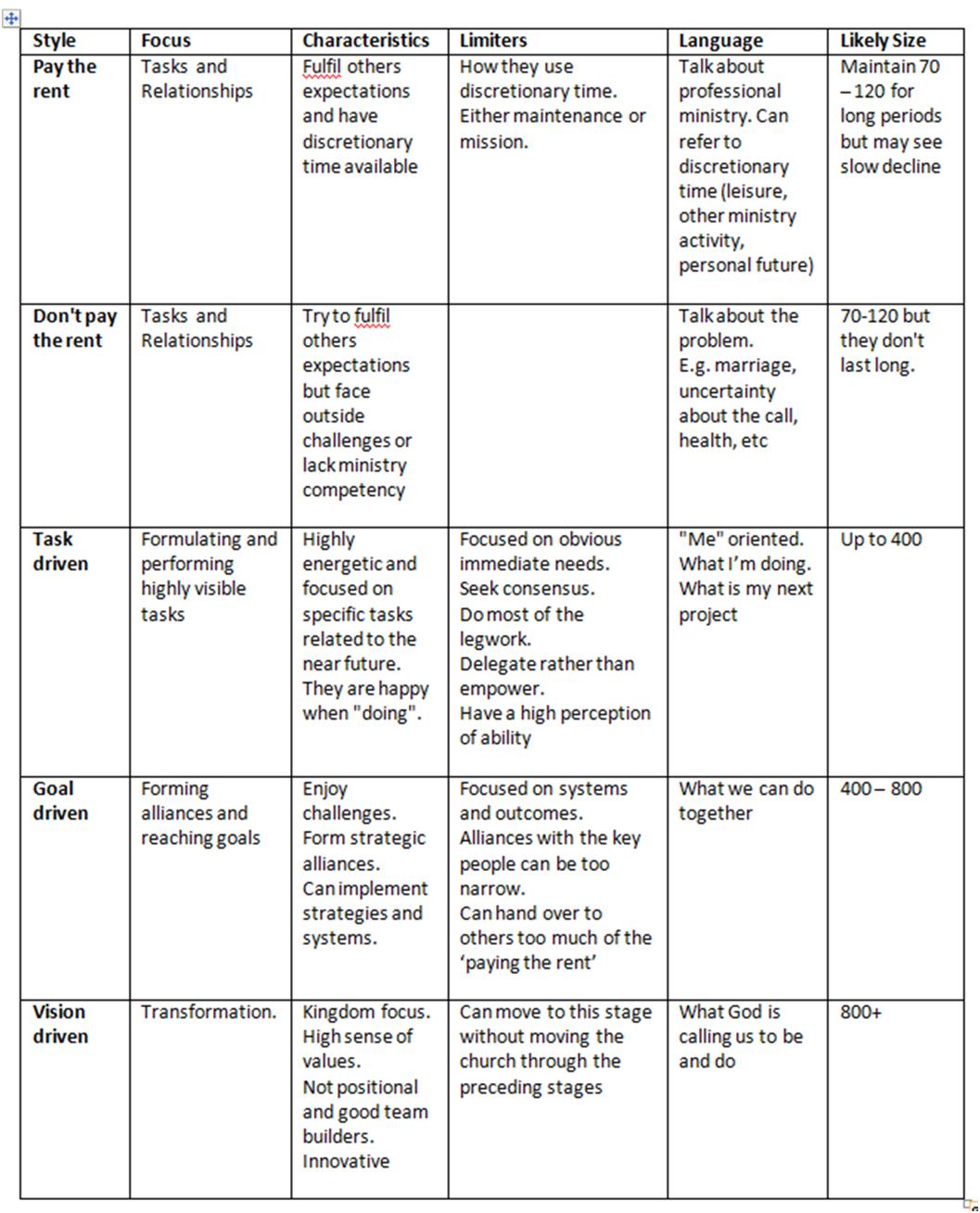
Adapted from “The Very Large Church’ by Lyle E. Schaller

Colin Noyes is the Director of ResourceZone International. He has thirty-five years of ministry experience as a pastor, college lecturer and consultant/coach to consultants, denominational leaders and local church pastors. He can be reached at info@resourcezoneinternational.com


Comment here