
“It is not the strongest that survive, nor the most intelligent, but the one most responsive to change.”
This rule applies to all of us in today’s world – we must try to adapt to change not only to survive, but to thrive, or grow because of it.
So what is change management?
Change management is a structured approach in individuals, teams, churches, other organisations and societies that enables the transition from a current state to a desired future state. The change referred to in this context includes a broad array of topics. From an individual perspective, change may be a new behaviour. From a societal perspective, change may be a new public policy or the passing of a new law. Successful change, however, requires more than a new process. It requires the engagement and participation of the people involved.
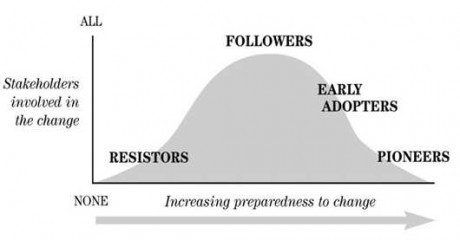
The change management process flow diagram shown here offers a simple model of how people typically react to change. Let’s use a church as an example.
Pioneers
Pioneers like change and often all things “new” because it gives them something fresh to explore. They are generally perceived as a little too curious, but they account for a large majority of the new approaches and inventions, even though they may be only 2-5% of the population.
Early Adopters
Early Adopters pay close attention to the Pioneers, and have the ability to more widely communicate the best of the Pioneer’s ideas to the rest of the church. The early adopters are a little more cautious about new approaches and change than pioneers but not by much. However they will typically make up 15-20% of any given church.
Followers (sometimes also called Late Adopters)
Followers want things to be main stream before they will accept a change. Usually this is done by watching the early adopter experience over a reasonable amount of time and making sure that any problems and difficulties have been “ironed out”. About 60% of the people in a church are Followers.
Resistors (sometimes also called Laggards)
Resistors will generally stay with what they have “always done” even if it is fairly obvious to everyone else that newer ways are better. Some may even actively resist a change to hold on to the familiar or the tried and trusted ways. Resistors typically account for around 15-20% of any given population.

© Colin Noyes is the Director of ResourceZone International. He has thirty years of ministry experience as a pastor, college lecturer and consultant/coach to consultants, denominational leaders and local church pastors.
Related Resources
- Change Management: Skill Builder Booklet (Ministry Specific Resource – PDF)
- Change Management: Coaching Storyboard (Ministry Specific Resource PDF)
- Managing Change: Coaching Storyboard Coaching Guide (Ministry Specific Resource PDF)
- Change Management Effectiveness Profile (Ministry Specific Resource PDF)


Comment here